 |
Artichokes: How do you cook artichokes?
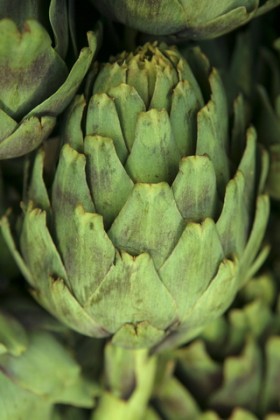
Fred recently e-mailed the Kitchen Shrink to ask , “How do you cook artichokes?” I have been asked that so frequently that I included my favorite way in Sara Moulton Cooks at Home. I always steam whole artichokes rather than boil them. They lose some flavor and get watery when you boil them. Place a steamer basket in a large soup pot with a lid. Add 1 inch of water to the pot. Cut the stems off the artichokes so they sit evenly and set the stems aside. Pull off and discard any small discolored bottom leaves. If you wish, you can trim off the tips of the leaves but it isn’t really necessary as the thorns become soft when cooked. You can spread the leaves and scrape out the fuzzy purple “choke” before cooking or cool the artichokes slightly after cooking and do it then. Place the artichokes pointed side up in the steamer and steam over low heat until the leaves pull off easily, 40 to 45 minutes. About 15 minutes before you think the artichokes are tender, peel the reserved stems and add them to the steamer. Serve all with melted butter. Because artichokes are so sweet and so much fun to eat, kids are likely to give them a try and forget they are a vegetable.
Asparagus: When should you peel asparagus and when don’t you have to?
Kathy e-mailed the Kitchen Shrink to ask how you decide when to peel asparagus and when it is all right to leave it unpeeled.
Asparagus comes in all different thicknesses, from pencil-thin to nearly an inch. The bottom woody inch or two of any asparagus should be discarded. Whether or not you peel the stalks depends upon their thickness. The larger the asparagus, the tougher the peel, and the more likely they are to need peeling. I usually peel the stalks if the asparagus is 1/2-inch in diameter or larger. Large asparagus stalks tend to be much thicker at the bottom than at the top, so peeling makes them more uniform and they will cook more evenly. To keep the stalk from snapping during peeling, place it on a flat surface and run a vegetable peeler from just below the tip all the way to the bottom.
Baking: How can I get my cookies to brown evenly?
Sharon e-mailed the Kitchen Shrink that her cookies always get dark on the bottom before the top begins to brown. She wondered what she can do to get them to bake evenly.
There are several things that affect the way cookies brown. The best way to get them to brown evenly is to bake them on light-colored baking sheets in the center of an uncrowded oven. Dark baking sheets hold the heat and brown the bottoms of cookies faster than do shiny aluminum or stainless-steel baking sheets. Insulated baking sheets practically insure that cookie bottoms will not get too dark. In the oven, heat is reflected from all sides onto whatever you are baking. The center of the oven is the best place for cookies to get even heat. If it appears that the tops aren’t browning well, move the baking sheet to the top shelf and the cookies will receive more reflected heat from the top of the oven. If the bottoms need more browning or the cookies are very thick, move the sheet to the bottom shelf. It is important to allow room around all the baking sheets so that the heat can circulate properly. If you are using a convection oven, it will circulate the heat more efficiently and bake your cookies faster. Never line the bottom of your oven with aluminum foil. While it makes cleaning easier, it reflects a lot of heat onto the bottom of your baking sheet and causes uneven browning.
Biscuits: How can you make your own biscuit mix?
Sharon e-mailed the Kitchen Shrink to find out how to make homemade biscuit mix. You will find a number of recipes on line for a homemade substitute for commercial biscuit mix but you can actually just use your favorite biscuit recipe, combine the flour, sugar, baking powder, and salt in a food processor and pulse in the butter or shortening until it forms crumbs. Transfer the mixture to an airtight container and store it in the refrigerator or freezer until you are ready to use it. You can use a measured amount of it as you would biscuit mix in a recipe or just stir in milk to make biscuits. Commercial biscuit mix contains preservatives so that it can be stored at room temperature but your homemade biscuit mix that includes butter or vegetable shortening really needs to be stored in the refrigerator or freezer. Cream Biscuits, my favorite biscuit recipe, calls for heavy cream to provide both the shortening and liquid so you can stir together the flour, sugar, baking powder, and salt in a tight container and store it at room temperature then stir in heavy cream when you want to make biscuits.
Black-eyed Peas: What is a good way to serve black-eyed peas?
Sharon e-mailed the Kitchen Shrink that she wanted to cook black-eyed peas for New Year’s Day but wasn’t sure how to prepare them so that her family would like them. Serving black-eyed peas on New Year’s Day to bring good luck and prosperity has been a tradition in the South-East since the Civil War and there are lots of ways to serve them.
Black-eyed peas are available dried, canned, frozen, and occasionally in the produce section rehydrated so they will cook quickly. If you have dried black-eyed peas, see my cooking instructions below. If you have frozen, or rehydrated, cook them following package directions. And, if you have canned ones, just drain and rinse them. Once you have cooked beans, they can be combined with rice and ham or sausage for a traditional Hoppin’ John, combined iwth cooked greens and ham, tossed with dressing for a salad or “Texas Caviar,” pureed and seasoned for a dip, or (my favorite) made into cakes and served with a delicious sauce. Check out my recipe for Black-Eyed Pea Cakes with Salsa Mayonnaise.
If you have dried black-eyed peas, here’s how to cook them:
Black-eyed peas are really beans and are cooked as you would cook other dried beans. Pick through them and discard any discolored peas and small stones. Rinse the peas thoroughly and bring them to a boil over high heat in unsalted water to cover by several inches. Reduce the heat to low, cover the pan, and simmer the peas until they are tender, 45 to 60 minutes, adding salt half way through the cooking time. The cooking time for dried beans of all sorts varies a great deal depending upon the temperature at which they have been stored and the amount of time they have been on the shelf.
Blueberries: Blueberry Muffin Tips
 A viewer recently e-mailed me to say that when she added fresh blueberries to her favorite muffin batter the finished muffins had an unappetizing greenish haze around the blueberries. She wondered what caused it and if there is a way to prevent that from happening.
When you bake with fresh or frozen blueberries, the color is affected by the level of acidity in the batter. If the batter has a bit too much baking soda, the blueberries turn green around the edges. You can balance the acidity by using a recipe that calls for buttermilk or another acid, such as orange juice or lemon juice.
Another problem that I get an occasional question about is, How can I keep the blueberries from all ending up on the bottom of my muffins?” One solution is to use a thicker batter. Or, don’t mix the blueberries into the batter at all. Fill the muffin cups two-thirds full with batter, then dot the tops with several blueberries. They will distribute themselves as the muffins bake.
Broccoli: What can you do with broccoli stems?
Sandy e-mailed the Kitchen Shrink that she hated to throw away the stems from fresh broccoli and wondered what she could use them for.
Broccoli stems are just as delicious as the tops and can be used in either raw or cooked dishes. You should trim off the bottom 3/4- to 1-inches of the stem and peel the rest. Then it can be thinly sliced or cut into matchsticks and cooked with the tops or used in a stir-fry. It can also be coarsely shredded and tossed with salad dressing for a slaw or quickly sauteed in olive oil with a little garlic for a side dish.
Brussels Sprouts: What is the best way to cook Brussels Sprouts?
Theresa e-mailed the Kitchen Shrink that the Brussels sprouts in the market look especially good this year but she doesn’t know how to cook them so that her family will like them.
Too many people have memories of Brussels sprouts that have been boiled until they are gray. There are a number of ways to cook Brussels sprouts with delicious results as long as you cook them until they are crisp-tender and still bright green. I wasn’t a fan of Brussels sprouts until Sue Fenniger and Mary Sue Milliken made Quick Sautéed Shredded Brussels Sprouts on one of my shows. You’ll find that recipe on page 243 of my first book, Sara Moulton Cooks at Home. They shred the sprouts and stir-fry them but you can trim and halve them then sauté, stir-fry, or deep fry them quickly for equally good results. You can also toss trimmed halved or whole Brussels sprouts in olive oil or butter and kosher salt and roast them until they just begin to feel tender. Small Brussels sprouts can be trimmed, shredded, and served raw with an oil and vinegar dressing.
Burgers: How can I keep burgers from plumping in the center?
Whenever I demonstrate one of my burger recipes, someone asks if there is a way to keep burgers from plumping in the center and becoming smaller in diameter as they cook.
My favorite trick to solve this problem is to create an indentation in the center when I shape the burgers and to make them a bit bigger than the bun so that when they do what comes naturally, they turn out the size and shape I want.
Caramel: Is there an easy, fool-proof way to make caramel?
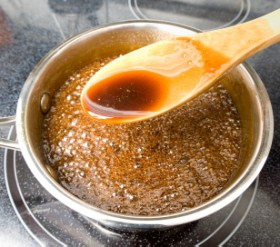
Norma recently e-mailed the KitchenShrink to ask, “Is there an easy fool-proof way to make caramel?” I had been asked this question so often over the years that I included my favorite way to make caramel in Sara Moulton Cooks at Home. You can find it on page 54 and an in depth explanation of why I think it is the best method on page 55. Here are the instructions: “Place the sugar in a heavy skillet or saucepan and cook over medium heat, stirring gently, until the sugar starts to melt. Stop stirring and continue cooking, swirling the skillet or pan often, until the sugar cooks to a dark golden caramel.” Use immediately as directed in the recipe or pour onto an oiled baking sheet to cool as it will continue to darken if left in the hot pan.
Cheese: Fresh or processed mozzarella?
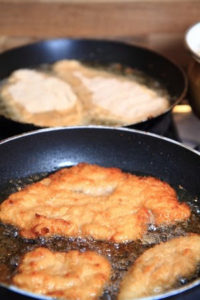
I recently got a question from Frank who wanted to make fried mozzarella cubes that are light, smooth, and stretchy “like eating a toasted marshmallow” rather than heavy and chewy. I told him that the secret is in the mozzarella and he may have to try several kinds before he finds the one that melts to meet his description. There is a big difference between the texture and cooking properties of fresh mozzarella and processed mozzarella. Fresh mozzarella is hand molded into balls, stored in brine or whey until it is used, and should be served very soon after it is made. It is a special treat that is best enjoyed in salads and sandwiches, cold or at room temperature, where its delicate flavor shines. Factory-made processed mozzarella is lower in moisture, has a longer shelf life, and is easily sliced, cubed, or grated. It is most often used in cooked dishes because it really does melt better than fresh mozzarella. Although I have had fried mozzarella made with fresh mozzarella “bocconcini,” most recipes call for processed mozzarella sticks or cubes and I think that would be a god place to start.
Cheese: What are good melting cheeses?
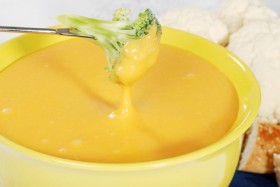
Blondell recently e-mailed the Kitchen Shrink to ask, “Which cheeses can be melted and poured?” While most people know that processed cheeses melt smoothly and easily into sauces, selecting a natural cheese that behaves as well isn’t always easy. Many hard grating cheeses don’t melt well and those known for their stringiness and chewy texture tend to maintain that texture when warmed, but the list of those that do melt well into sauces gives pretty much choice at the cheese counter. If you follow the tips below, you can count on a smooth sauce when you use Asiago, Cheddar, colby, fontina, Gouda, Gruyère, Havarti, Monterey Jack, or Muenster. Blue cheeses and soft cheeses such as Brie and Camembert also melt well if you remove the rind. When melting cheese, the following tips will help insure a smooth sauce. Bring the cheese to room temperature before using, grate or finely chop the cheese, thicken the sauce before adding the cheese, and heat only until the cheese has melted. Overheating can make the cheese harden and release fat creating a lumpy sauce.
Chocolate: What is the best way to melt chocolate?
One of the most frequent questions that come in to the Kitchen Shrink is, “How can I melt chocolate without the risk of it scorching or suddenly getting firm.” Chocolate is very sensitive to heat and it is best to melt it slowly. I like to melt it in the top of a double boiler or a metal bowl set over water that has come to a boil and then been removed from the heat. Be patient and when it looks as if much of it has melted, remove it from the hot water and whisk it until it is all melted and smooth. You can also set a heat-proof glass measuring cup into the pan of hot water and add the chocolate to the cup. Be careful not to let any of the water splash into the cup because, while you can melt chocolate with a liquid as long as you have at least a tablespoon of liquid per ounce of chocolate, small amounts of a liquid will cause chocolate to “seize” and become hard and lumpy. If you do have that happen, you might be able to save the chocolate by quickly stirring in 1/2 teaspoon vegetable oil per ounce of chocolate. You can also melt chocolate in a microwave, but be sure to use 50% power and microwave for short intervals at a time. Whisk, and if you don’t have a turntable in your microwave, turn the dish frequently.
Clams: How do you store and clean clams?
Bob e-mailed the Kitchen Shrink to find out how to store and clean shellfish such as clams before cooking.
It is best to purchase clams just before cooking them so there should be little storage to worry about. Clams are purchased alive and must be kept alive. If you do purchase them several hours in advance, they should be kept cool and moist on ice or in the refrigerator. Don’t wrap them in anything airtight; they need oxygen to survive. Just before cooking, scrub them with a stiff brush under cool running water and trim off beards if they have them. If any are open, tap the shell. If they don’t close tightly, discard them. If any don’t open when cooked, discard them. All of the above goes for mussels as well.
Coconuts: How do I open a fresh coconut?
A few weeks ago Blondell asked the Kitchen Shrink how to open a fresh coconut and, with the spring holidays just around the corner, this seems like the perfect time to share my favorite method for this tricky procedure.
I have tried lots of different ways of cracking a coconut but the one published in Gourmet always seems to be the easiest. Preheat the oven to 400°F. Thoroughly rinse and dry the coconut. With a metal skewer, ice pick, or clean screwdriver, poke a hole in the softest eye of the coconut. If possible, poke a hole in another eye of the coconut because that will make the coconut water drain more efficiently. Invert the coconut over a glass measuring cup and let it drain. Taste the coconut water; if there is any off flavor, the coconut is not good and should be discarded. Place the coconut in a rimmed baking pan and bake 15 minutes. The shell will probably crack in the oven. If not, crack it with a hammer and separate the pieces. Set aside until cool enough to handle, then pry the coconut away from the shell and peel off the brown skin with a vegetable peeler. Shred the coconut pieces with a microplane or a grater. You can also use a food processor but you are likely to get some little chunks among the shreds. Use the coconut in any recipe calling for unsweetened coconut or pack it in a freezer container and freeze for up to 3 months.
Cookies: Why do cookies deflate after baking?
Pam recently e-mailed the Kitchenshrink with several questions. With the help of my friend Jean Anderson, I answered one last week and Jean and I will take on the second this week, “Why do cookies deflate when you take them from the oven. Especially chocolate chip?” My thought was that Pam might be using the new Crisco that certainly produces different results than the original. Here’s Jean’s answer: “The shortening is key. The new Crisco may have caused the cookies to fall but so might substituting margarine for butter or using one of the new soft spreads in place of good old-fashioned stick butter — my choice for all cakes and cookies these days. It’s also possible that the cookies contain too much sugar — the culprit in fallen cakes. I’d suggest that the reader retry the recipe using stick butter and 2 to 3 tablespoons less sugar (depends, of course, on the quantity of sugar called for — I’m assuming that this is a fairly classic chocolate chip cookie recipe). These adjustments should solve the problem.” For more kitchen wisdom, visit Jean’s website, www.jeanandersoncooks.com.
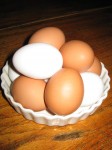
Eggs: Perfect Hard-cooked Eggs
This time of year I get a lot of e-mails asking me about the special technique for hard cooking eggs that I learned from Julia Child. When I was writing my latest cookbook, Sara’s Moulton’s Everyday Family Dinners, I made the process even easier and here it is:
Sara’s Hard-cooked Eggs
This is my streamlined version of Julia Child’s fool-proof method of hard-cooking eggs. In a nutshell, Julia figured out that the way to hard boil an egg is to stop short of actually boiling it. Boil it and all you’ll do is guarantee that the thing ends up damn near as hard and rubbery as a hockey puck. Instead, you start the eggs in cold water, bring them almost to a boil, pull them off the heat, and then cover and set them aside while they finish cooking. Finally, you plunge them into ice water and let them cool completely before peeling, a little trick that eliminates the nasty green line that would otherwise appear between the whites and the yolk. Do it this way and you’ll turn out perfect hard-cooked eggs every time.
Large eggs, at room temperature
Place the desired number of eggs in a saucepan large enough for them to fit in a single layer and add enough cold water to cover them by 2 inches. Bring the water to a boil over medium heat.
Remove the saucepan from the heat, cover it, and set it aside for 13 minutes.
Transfer the eggs to a bowl of half ice and half water. Cool them completely; then refrigerate or use as directed in a recipe.
Frosting: Why soda in caramel frosting?
I recently got an e-mail from Dean asking why some recipes for cooked Caramel Frosting (the kind without confectioners’ sugar, also called Caramel Fudge Frosting) call for baking soda and some don’t and wondering, “What is the reason for using baking soda and what is the difference in the outcome of both ways of making the icing?”
Although I know that you can add cream of tartar or white corn syrup to prevent crystallization in the finished frosting and when making peanut brittle you add baking soda to give the clear sugar syrup the characteristic porous texture, I also know from baking that if there isn’t enough acid in a mixture to neutralize the soda, it will leave a bitter, soapy taste. I couldn’t think of any positive reason for adding baking soda to Caramel Frosting so I asked my friend and mentor, Jean Anderson (author of From A Southern Oven) what she knew about baking soda in caramel frosting. She said, “I see no need for it. You’re just adding more sodium. If a little cream of tartar has been added to the caramel syrup to prevent crystallization, this tiny bit of added acid may be why some recipes call for soda – “to temper it.”. . . I personally wouldn’t add soda.”
Garlic: Is there an easy way to peel garlic?
Frank e-mailed the Kitchen Shrink that he likes to use lots of garlic but hates to pick the white papery skin off. He wondered if there is an easy way to do this.
I usually arrange the cloves, with a flat side down, on my work surface and whack them with the flat side of a heavy knife. The skin pops right off. If you feel uncomfortable with that, press on them with something flat such as a wide spatula or the bottom of a can. There are also some clever devices on the market such as a flexible tube that removes the skin. You can take a look at them in your favorite kitchen shop or online at Williams Sonoma.
Herbs: Substituting fresh for dried herbs
Callie e-mailed the Kitchen Shrink to ask, “I am growing my own herbs this Spring and want to use them in all my recipes! However, most recipes call for dried herbs. Is the measurement of dried herbs the same for fresh herbs or should I uses less since the herb is fresh and more pronounced than the dried version? Actually it is just the opposite. Herbs are reduced in size when dehydrated so you need less dried than fresh. In Sara Moulton’s Everyday Family Dinners, I note that “1 tablespoon chopped fresh herbs equals 1 teaspoon dried herbs” and suggest that since chopping reduces the volume of fresh herbs, it is important to always chop them before measuring when the ingredient list calls for chopped.
Herbs: What Is The Best Way To Store Fresh Herbs?
Put leafy herbs, such as basil, parsley, dill, and cilantro in a glass or glass measuring cup with water in the bottom (like cut flowers), cover with a plastic bag loosely over the top, and store in the fridge. They will keep for a week if set up this way. Woody herbs, such as rosemary and thyme, should be wrapped in paper towels, then a plastic bag, and kept in the crisper.
High altitude baking: What can I do to bake successfully in high altitude?
I recently got an e-mail from Nancy asking, “Why are my cookies always flat?” It turns out that she lives in Calgary and the increased altitude is affecting her baking. Fortunately there is lots of help these days. A recent book by renowned baker, Susan G. Purdy, is devoted to high-altitude baking. You can learn more at highaltitudebaking.com. There is also a wealth of information at kingarthurflour.com and swcoloradohome.com.
Limes: How can I get the most juice from a lime?
Betty e-mailed the Kitchen Shrink that she had some limes that were especially firm and wondered if there was a “secret” to getting the most juice from them.
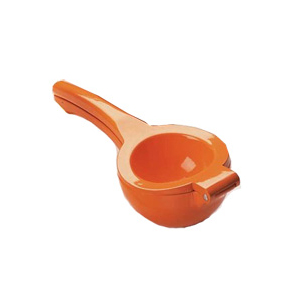
Now there is a question that I get so frequently that I put a sidebar in Sara Moulton Cooks at Home with some tips that will help. Both lemons and limes vary in juiciness and in firmness and you want to get all the juice you can when you squeeze them. I have found that any of the following three methods help a lot. Before you cut the lime in half to squeeze it:
- Roll it on the counter, pressing down firmly on it 5 or 6 times. Or,
- Pierce it once with the point of a knife and nuke it in the microwave for 20 seconds. Or,
- Bake it in a preheated 300 degree F oven for 10 minutes.
Meat: How Can I Thinly Slice Raw Meat?
Steve e-mailed the Kitchen Shrink to ask if there was a trick for thinly slicing raw meats for stir fry.
As I mention in my recipe for Japanese Beef Fondue, the best way to thinly slice meat without a fancy slicing machine is to partially freeze the meat so it is firm enough to keep its shape but not to resist the knife. In the recipe I suggest about 30 minutes but that depends on the initial temperature of the meat and the thickness of the cut. It is best to test it for firmness after 30 minutes and return it to the freezer if it needs more chilling.
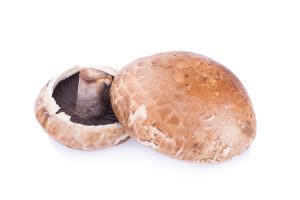
Mushrooms: Why do you suggest removing the gills from portobello mushrooms?
While it is not necessary to remove the gills from portobello mushrooms before you use them, I feel that there are some good reasons to take the time to do it. The dark gills share their color with everything they touch and will discolor (turn black) any stuffings, sauces, and salad dressings that accompany the mushrooms in the recipe. Also, the gills sometimes hide a little sand from the substrate on which the mushrooms were grown; scooping them out prevents any grittiness in the finished dish.
Peppers: What is the easiest way to roast peppers?
Erin e-mailed the Kitchen Shrink that she wanted to make a recipe that called for roasted peppers and she wondered if there is an easy way to make them.
There are a number of ways to roast peppers; all are easy. I used roasted red peppers a number of times in Sara’s Secrets for Weeknight Meals and included these instructions on page 30 of the book to help readers make them. If you have a gas stove, turn on one burner to a low flame for every four peppers you want to roast. Arrange the peppers directly on the grate over the flame and turn them often using tongs until they are blackened on all sides. If you have an electric stove, place a rack 4 inches from your broiler’s heat source and preheat the broiler to high. Place the peppers on the rack and char them as directed above. Either method will take 10 to 15 minutes. Then transfer the peppers to a bowl, cover tightly with plastic wrap and set aside until they are cool enough to touch. Working over a bowl to catch the juice, quarter each pepper, discard the stem and seeds; pull off and discard the skin and use the peppers as directed in your recipe. Don’t rinse the peeled peppers as that removes some of the flavor. The juices you have caught in the bowl are a delicious addition to soups and sauces.
Pumpkin seeds: How do you toast pumpkin seeds?
Each year at this time I get e-mails from viewers asking how to prepare toasted pumpkin seeds. Toasting pumpkin seeds is easy, lots of fun, and a good activity to do with children after you carve your jack-o-lanterns. Just place a rack in the center of the oven and preheat the oven to 350°F. Separate the seeds from the stringy membrane you have removed from the center of the pumpkin and rinse them until they don’t feel slippery. Dry them with paper towels, toss them with some vegetable oil and kosher salt, and spread them out in one layer on a baking sheet. Bake them for 10 to 15 minutes, stirring occasionally until they are golden and crisp. In addition to crunching them for a snack, I like to use them as a garnish on my pumpkin soup and on salads.
Salad Dressing: Can you give me an easy all-purpose salad dressing?

The Kitchen Shrink has gotten several requests for a good homemade salad dressing recently, so it seems like a good time to remind you of my favorite vinaigrette. My refrigerator is never without it. It is good on any basic savory salad and can be varied by changing the oil and vinegar you use. You can also vary it by adding a little fruit juice when fruit is included in the salad, or some soy sauce and sesame oil for an Asian-style dressing, or your favorite hot sauce for a South-western dressing; or whisk in a little mayonnaise or sour cream to use it on potato salad or coleslaw. Here’s the recipe:
Combine 1/4 cup white wine, red wine, or sherry vinegar, 1 teaspoon Dijon mustard, and 1/2 teaspoon kosher salt in a 1-cup glass measuring cup and whisk with a fork until the salt is dissolved. Slowly add 3/4 cup extra virgin olive oil in a stream, whisking. Cover and refrigerate; set out at room temperature for a few minutes before using .
Sauces: How do you use cornstarch and arrowroot to make clear thickened sauces?
Michael e-mailed the Kitchen Shrink with this question. He said that he wanted to make clear dessert sauces and had heard that cornstarch or arrowroot was the answer but he had never used either.
Cornstarch and arrowroot are similar ingredients to work with. Both have almost twice the thickening power of flour. Cornstarch, which is inexpensive and a staple in most home pantries, produces a clear, shiny sauce while arrowroot, a more expensive ingredient found in the spice section of the supermarket, produces an even clearer sauce. To thicken a sauce with either cornstarch or arrowroot, whisk the starch into a cool or room temperature liquid and then into the sauce. Don’t allow the sauce to cook too long after thickening or the starch will lose some thickening power.
Seafood: Is it better to buy wild or cultivated mussels?
Mary Lou e-mailed the Kitchen Shrink that she was confused by the choice of mussels in her market. She wondered if wild or cultivated mussels are the best choice.
Most of the mussels we find in restaurants, fish stores and supermarkets are blue mussels from North Atlantic waters. They probably came from Prince Edward Island, Newfoundland, Nova Scotia or Maine. You can tell right away whether they are wild or cultivated. Wild mussels have larger rougher looking shells, often with beards (a hairy string from the side of the shell) and barnacles attached. Cultivated mussels have small smooth dark shells and negligible beards, if any at all. The wild mussels are stronger in flavor, almost gamey. They also contain more grit than the cultivated. I prefer the more delicate taste and tender texture of the cultivated.
Shrimp: How can I cook shrimp so they will stay tender?
Terri e-mailed the Kitchen Shrink to ask for help in cooking shrimp. She said that no matter how she cooks them, her shrimp seem tough.
Whether you deep fry, sauté, stir-fry, steam or boil shrimp, they cook to tender, juicy perfection very, very quickly and then overcook. Shrimp should be cooked just until they turn color and then removed before they are cooked through. The stored heat will complete cooking them. If shrimp are going to be a part of a mixed dish, it is best to cook them first and remove them from the heat. Then stir them into the finished dish just before serving.
Tripe: How do you cook tripe?
Last week Randy asked me this about tripe, “I see this all of the time in the grocery store and I have to be honest, while it sort of scares me, it also fascinates me. Is there a way to cook this so that is actually tastes good? Is it healthy? It certainly is cheap.”
Tripe seems to be making a comeback in the culinary world. You can cook it to make delicious and very inexpensive dishes but it takes a bit of time. I immediately thought of my friend Jean Anderson and asked her for some information to help me answer his question. Jean has written about tripe in several of her cookbooks and told me that tripe is the lining of the stomach of ruminants such as sheep, goats, and beef cattle. Many people use the lining of the first three sections of the stomach but Jean recommends the lining of the second section, known as honeycomb tripe as well as pocket tripe from the lower end of the second section. She says that tripe is available pickled, canned, and fresh. Even the fresh tripe needs a lot of additional cooking. Purchase 1/4 to 1/2 pound of tripe per person to be served. When using fresh tripe, remove and discard all fat, rinse it thoroughly in cold water, and cut it into manageable pieces; although it has already been partially cooked, you will need to simmer it, covered, 1 1/2 to 2 1/2 hours until it is tender before using it as directed in a recipe. You will find many delicious ways to serve tripe in Jean Anderson’s Foods of Portugal and The New Doubleday Cookbook. As for nutrition, it’s not a big hitter. A quarter pound of raw tripe contains 17 grams of protein, 4 1/2 grams of fat (2 1/3 grams of which are saturated), not carbohydrate or fiber, 306 milligrams of potassium, 52 milligrams of sodium and some trace minerals.
| |
| |