

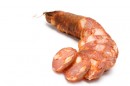
 I recently got an e-mail from Cecilia who wondered why Jasper White was using Spanish chorizo in his Portuguese Cataplana (you can find his recipe at Cataplana) and thought perhaps he was using the Portuguese sausage linguica. I immediately forwarded her question to my friend and cookbook author, Jean Anderson whose book, The Food of Portugal, won a Tastemaker Best Foreign Cookbook Award and is still going strong after more than 20 years. Jean has taken so many trips to Portugal and written so much about it for food and travel magazines in this country that the government of Portugal made her an honorary citizen.
Here is her answer:
There is an equally popular Portuguese sausage called chouriço (cedilla under the second C), which is similar to the Spanish chorizo and can be used interchangeably. I feel certain that that’s what Jasper meant. In fact, although they sound pretty much alike when spoken, that’s what he called for in the recipe. I devote a full page to Portuguese sausages in my Food of Portugal (page 61 in the paperback version). Here’s what I say:
Chouriço (pronounced shure – REET -zo): This is probably Portugal’s most popular sausage. It’s even made by Old-Country methods in some of America’s Portuguese communities. A dry sausage similar to the more popular Spanish chorizo (which may be substituted for it in recipes), chouriço is very garlicky, red-brown with paprika, and sold in links about 10 inches long and 1 1/2 inches in diameter. In the fado houses of Lisbon (fado is Portugal’s soul music) grilled chouriços are so much a staple they are know as “fado sausages.” They are brought to the table on little alcohol-fueled terracotta braziers shaped like pigs. The alcohol used to fuel those little chouriço braziers is usually the Portuguese aguardente (fire water, sometimes medronho made from the fruit of the strawberry tree). It’s poured over the sausage on the brazier at the table, the waiter flames it, then you wait till the flames die before digging in. These sausages fairly spurt juice, they are crusty-black after being flamed, and they are soooooo delicious!
Linguiça (cedilla under the C; prounced lin-GUEE -zah): This dry sausage is not, as has been written, made of tongue. It consists of coarsely chopped pork shoulder (both the lean and the fat), plenty of garlic and paprika. Its shape, rather like a long and slender lingua (tongue) explains the name. You can find it in the many Portuguese communities in the US on both the Atlantic and Pacific coasts. These two sausages can be used interchangeably in recipes though chouriço is chunkier and juicier.

Wonderful answers that explain excellently the differences in sausages. I grew up next door to a family (mostly Grandfather) who made and sold both chourico and linguica, tho mostly chourico. It hung in his panel truck on way to market. Loved the odor, but really loved the taste.
I love your shows
in southern new england, and at least Lisbon, the name of the sausage phonetically is pronounced Cherese, (no second c, no o) as opposed to Spanish “chorizo”
Any recipes for making either sausage?
No, alas I do not.