

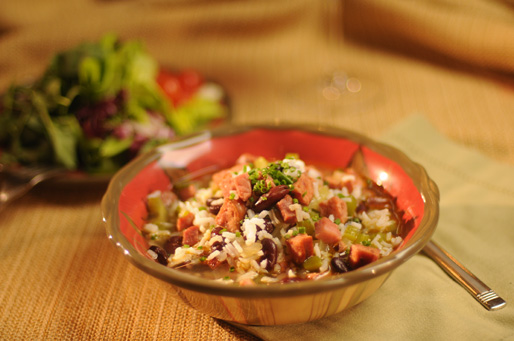
 Makes about 10 cups, 6 servings
Hands on time: 25 minutes
Total preparation time: 40 minutes
Suggested Accompaniment
Tossed Green Salad
Ingredients
2 tablespoons vegetable oil
6 ounces ham
1 large onion
4 medium celery stalks
1 large green bell pepper
3 garlic cloves
1 tablespoon Creole Seasoning (recipe follows)
1 pound fully cooked smoked andouille sausage
Two 15 1/2-ounce cans red kidney beans
6 cups chicken broth
1 Turkish bay leaf
1 1/2 cups cooked white or brown rice (1/2 cup uncooked rice equals 1 1/2 cups cooked)
Directions
1. Heat the vegetable oil in a 3-quart saucepan over medium heat. Medium chop the ham (about 1 1/3 cups) and add to the saucepan; cook until the ham is lightly browned, about 5 minutes. Transfer with a slotted spoon to a small bowl and set aside.
2. Meanwhile, medium chop the onion (about 2 cups), celery (about 2 cups), and bell pepper (about 1 1/2 cups). Add the onion to the saucepan and cook, stirring occasionally, for about 5 minutes, or until it is lightly browned. Add the celery and bell pepper and cook for 2 to 3 minutes. Press the garlic (about 1 tablespoon) into the vegetables in the saucepan; stir in the Creole Seasoning and cook 1 minute longer.
3. Halve the sausage lengthwise and slice it crosswise into ¼-inch thick pieces (about 3 cups); rinse and drain the beans. Add the chicken stock, sausage, beans, ham, and bay leaf to the vegetable mixture and simmer for 15 minutes. Discard the bay leaf, stir in the rice, heat, and serve.
Creole Seasoning
Yields about 1/2 cup
Combine 1 tablespoon plus 1 teaspoon hot paprika, 1 tablespoon kosher salt, 1 tablespoon garlic powder, 1 1/2 teaspoons freshly ground black pepper, 1 1/2 teaspoons onion powder, 1 1/2 teaspoons cayenne, 1 1/2 teaspoons dried oregano, and 1 1/2 teaspoons dried thyme in a small bowl. Transfer to a tight jar or tin and use as directed in a recipe.
Cook’s Notes
Cajun vs. Creole: The similarities between Creole and Cajun cuisines are due to the French heritage of both cultures, and the new ingredients to which French cooking techniques were applied by Creoles and by Cajuns. Both types of cooking have culinary roots in France, with a nod to Spain, Africa, and Native America, and to a lesser degree to the West Indies, Germany, Ireland, and Italy.
The cultural difference between the two methods of cooking lies in the fact that Creoles had access to local markets, and servants to cook their food while Cajuns lived mostly off the land, were subject to the elements of the seasons, and generally cooked meals in one large pot.
Creole cooking is city cooking: refined, delicate and luxurious, developed and originally prepared by servants. There is greater emphasis on cream, butter, seafood (though not shellfish), tomatoes, herbs, and garlic, and less use of cayenne pepper and file powder than in Cajun cooking, resulting in rich sauces, elegant pureed bisques, and time-intensive soups, brunch dishes, and desserts.
As a culinary term, the holy trinity refers specifically to chopped onions, bell peppers, and celery, combined in a rough ratio of 1:2:3 and used as the staple base for much of the cooking in the Cajun and Louisiana Creole regional cuisines of the state of Louisiana, USA. The preparation of classic Cajun/Creole dishes such as étouffée, gumbo, and jambalaya all start from the base of this holy trinity. Similar combinations of vegetables are known as mirepoix in French cooking, refogado in Portuguese, soffritto in Italian, and sofrito in Spanish.
Turkish bay leaves are 1”-2” long aromatic leaves with a more subtle flavor than the California variety, which are often 2”-3” long. They come from the evergreen bay laurel tree, native to the Mediterranean (Cooks Ingredients). I prefer to use Turkish bay leaves; the California variety can overwhelm a dish. If all you have is California bay leaves just use half the amount called for in the recipes.
You could leave out the sausage and ham and substitute vegetable stock for the chicken stock and you’ve got a lean vegetarian version of this winner.
Tips
Mix up a batch of Creole seasoning to have on hand to season chicken, beef, pork – and even popcorn! Makes a nice gift for someone who loves to grill.
This is the perfect kitchen opportunity for leftover rice from a Chinese take out. White or brown rice will both work.

Wow, this will be a family favorite from now on. The correct amount of spiciness, meat and vegetables. A quick recipe with slow cooked flavor. Thank you Sara.